
An email I got in September: “We land in Lanzhou on a Tuesday and fly out of Dunhuang on Friday night. Four days. Is that completely insane? Everyone says we need a week.” I wrote back that night, because I get some version of this question every month and the honest answer matters more than the polite one. No, it is not insane. It is tight, and there are two days where you will be in the car longer than you would like, but you can still stand on the coloured ridges at Zhangye, walk the rampart at Jiayuguan, watch the light go off the dunes at Mingsha and sit in a Mogao cave with a torch lighting up a face painted thirteen centuries ago. I know because I have driven it. What follows is essentially that email reply, expanded, with the bits I usually forget to mention until someone asks.
Short answer: Four days is the minimum I recommend for the Hexi Corridor from Lanzhou to Dunhuang. It covers Zhangye Danxia, Jiayuguan Pass and Dunhuang’s Mingsha Mountain and Crescent Spring, plus a half day at the Mogao Grottoes. Three days forces you to skip either the grottoes or the pass; five to seven days lets you add the Qilian grasslands or Qinghai Lake. I have driven this road more times than I can count, and four days is where it stops feeling like a race.
Before the logistics, let me put you on that first morning. It is 7:15 a.m. in Lanzhou, the noodle shop is already full, and the windows have gone completely white with steam. The man at the back is slapping dough against the counter in a rhythm you feel in your chest before you hear it. Someone sets a bowl in front of you: clear broth, a sheet of chilli oil still spreading across the top, coriander, white radish, noodles that were pulled thirty seconds ago. You are sitting on a low plastic stool with your coat still on, and the first mouthful is hot enough that you stop talking. I have watched this happen dozens of times with guests who landed the night before, jet-lagged and quietly worried about a four-day desert drive. By the second mouthful they have stopped checking their phones. That is why I always start here, and why I never schedule anything important before 9 a.m. on day one.
At a glance: 4 days on the Hexi Corridor
| Route | Lanzhou – Zhangye – Jiayuguan – Dunhuang |
| Distance | About 1,100 km by road, or two legs by high-speed rail plus a private car |
| Best months | Late April to June, and September to October |
| Altitude | 1,500-1,700 m. Low enough that altitude sickness is rarely an issue |
| Physical level | Easy. Short walks on viewing platforms and dune steps |
| Biggest planning risk | Mogao Grottoes tickets. They are name-based, released in advance and sell out in peak season |
I wrote this as the route I actually run for first-time visitors from Europe and North America who have four days and want the Silk Road highlights without a 6 a.m. start every morning. If you have three days, read my note in the FAQ; if you have a week, add Qinghai.
Day 1 – Lanzhou to Zhangye: noodles, then the rainbow mountains at sunset
I start guests with a bowl of Lanzhou beef noodles for breakfast, not a hotel buffet. The clear broth, hand-pulled noodles, white radish and chilli oil tell you more about this city than a museum does. Then we drive west, roughly 500 km, along the corridor with the Qilian Mountains on our left. If you would rather not sit in a car for five hours, the high-speed rail from Lanzhou to Zhangye is about three hours and I meet you at the station with a vehicle.
We check in around 4 p.m., rest, then head to the Zhangye Danxia National Geological Park for the last two hours of light. This timing is deliberate. The red, orange and yellow sandstone stripes look flat at noon and glow after about 5 p.m. in summer. I take guests to the West entrance and use the shuttle bus between platforms 1, 2 and 4; platform 4 is the sunset one, and platform 1 has the widest sweep. The whole loop takes about 2.5 hours on foot plus shuttle rides.
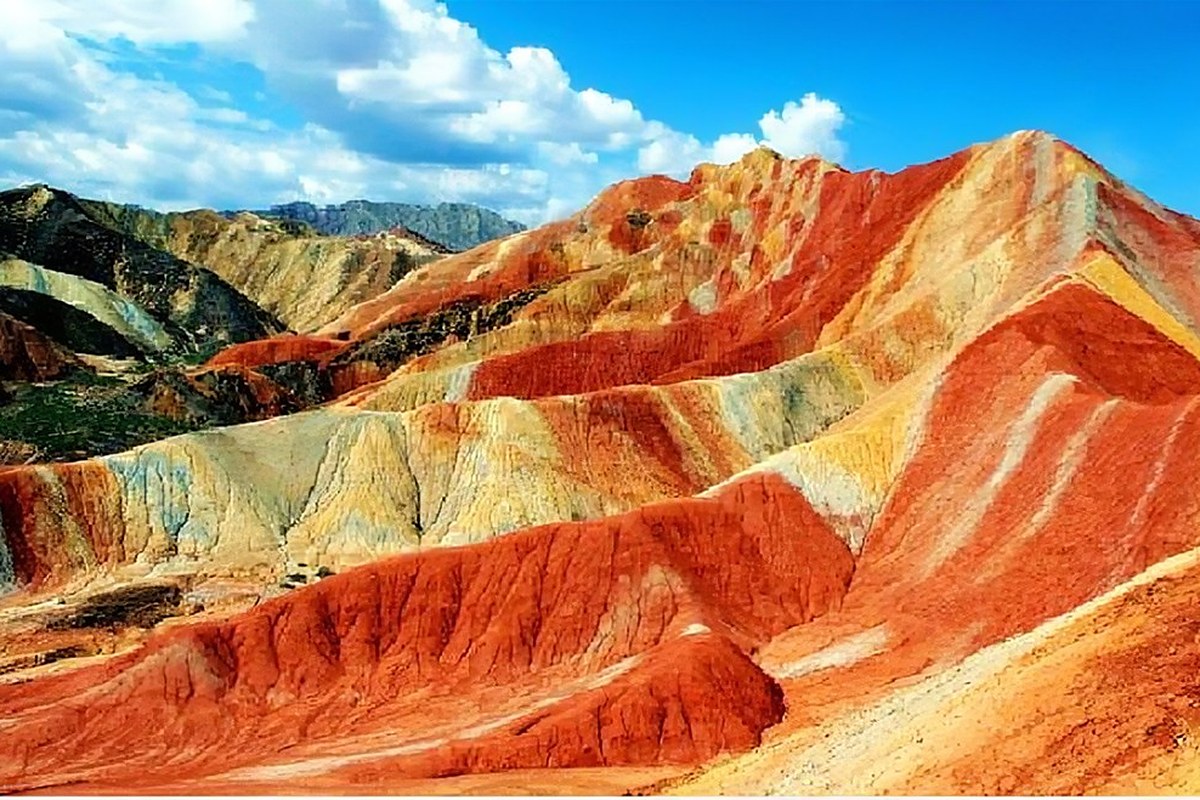
How I play the site: arrive 2.5 hours before sunset, ride the shuttle to platform 4 first to claim a spot, then work backwards. Stay on the boardwalks – the coloured crust is fragile and stepping on it is both damaging and fined. There is almost no shade, so a hat and water matter more than a camera lens here.
What I eat: Zhangye’s local speciality is cuo yu zi, short hand-rolled noodles in a savoury gravy, and chao pao, thick fried noodles. I take guests to a small shop in the old town rather than the restaurants at the park gate, which are priced for tour buses.
Where I sleep: in Zhangye city (Ganzhou district), not at the park. The park is about 40 km out of town, the gate hotels are isolated, and a city hotel means a real breakfast and a short walk to dinner.
Day 2 – Zhangye to Jiayuguan: the Great Wall at the edge of the desert
It is about 220 km to Jiayuguan, an easy morning. I usually add the Giant Buddha Temple in Zhangye before leaving – a 900-year-old wooden hall with a 35 m reclining Buddha, and a quiet counterpoint to two days of landscapes. Then we drive west into increasingly dry country.
Jiayuguan Pass is the western end of the Ming Great Wall, a fortified complex of a main gate, watchtowers and an outer wall with the Qilian snow peaks behind it. Give it two hours. I walk the ramparts clockwise, then visit the small museum inside the fort for the engineering models – it makes the rest of the corridor make sense. A few kilometres away is the Overhanging Great Wall, a steeper restored section on a ridge; I add it only if guests still have energy, because it is a lot of steps in full sun.
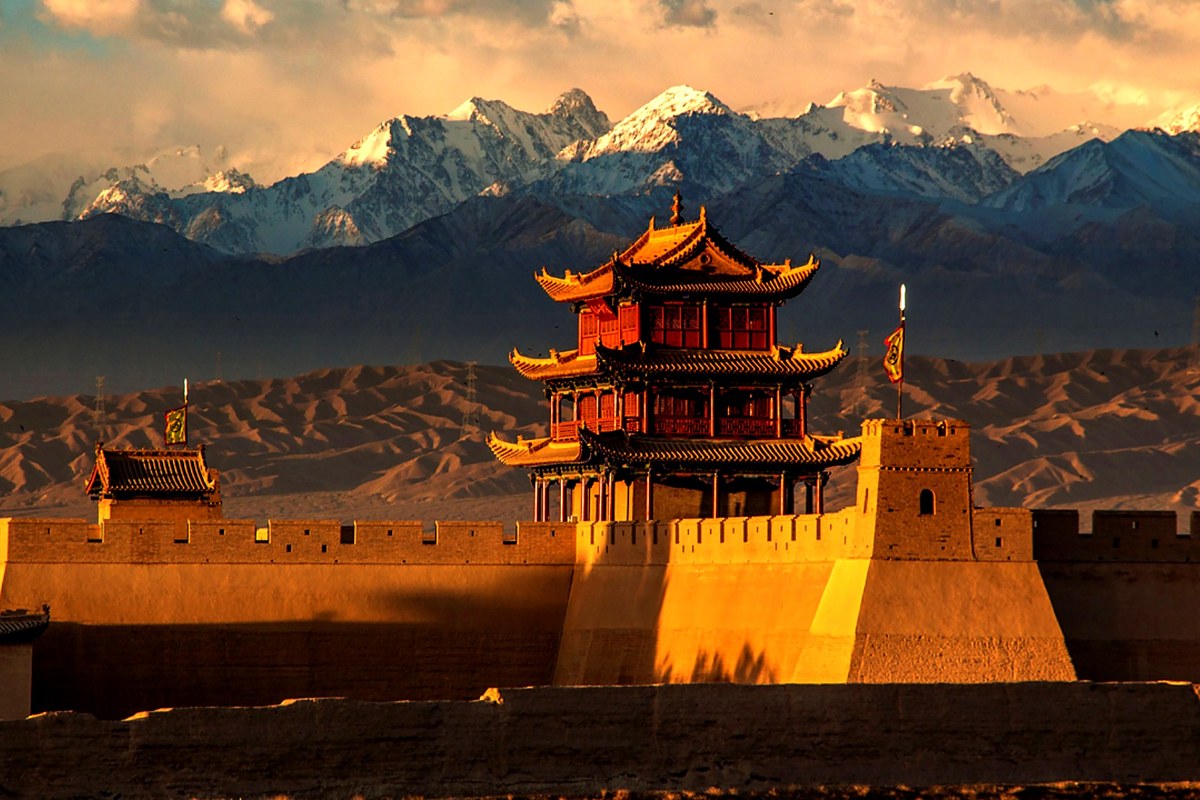
What I eat: Jiayuguan charcoal-grilled lamb skewers, ordered by the handful at an open-air barbecue street. Ask for kao yang rou and a local beer. It is the one meal on this route that guests consistently ask to repeat.
Where I sleep: Jiayuguan city, five minutes from the fort. Some operators push guests straight through to Dunhuang on day 2, which makes day 3 a 370 km dash plus a desert sunset. I would rather split it.
Day 3 – Jiayuguan to Dunhuang: dunes and an oasis that should not exist
Roughly 370 km of straight desert highway. We arrive in Dunhuang by mid-afternoon, and I keep the afternoon free for a nap – the heat between 2 and 5 p.m. in July and August is genuinely unpleasant. Around 5 p.m. we go to Mingsha Mountain and Crescent Moon Spring.
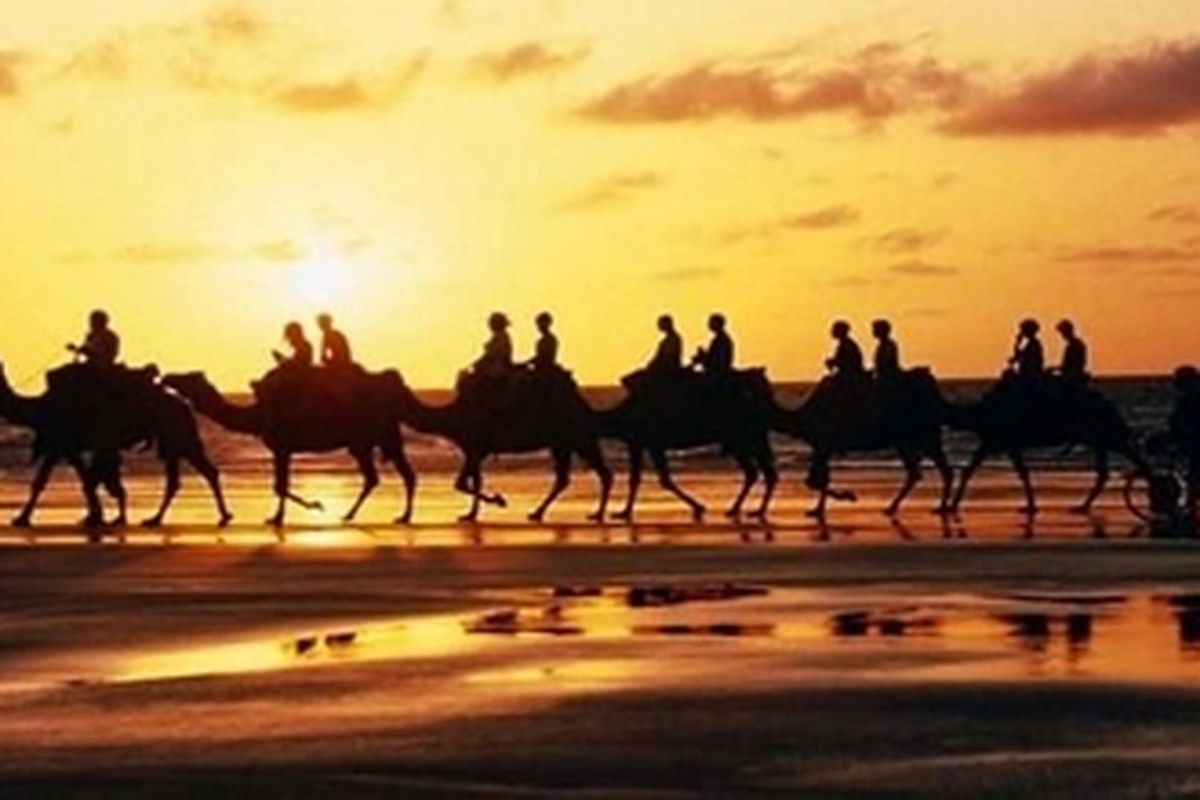
The site is a dune field with a crescent-shaped spring that has sat at its foot for centuries. I buy the ticket that allows re-entry the next morning, because one visit is rarely enough. We climb the dune via the wooden ladder (about 15 minutes, tiring but short), sit for sunset, then walk down to the spring pavilion in the dark. Camel rides are available; I book them for guests who want the photograph, but I warn them the ride is a short loop, not a desert expedition.
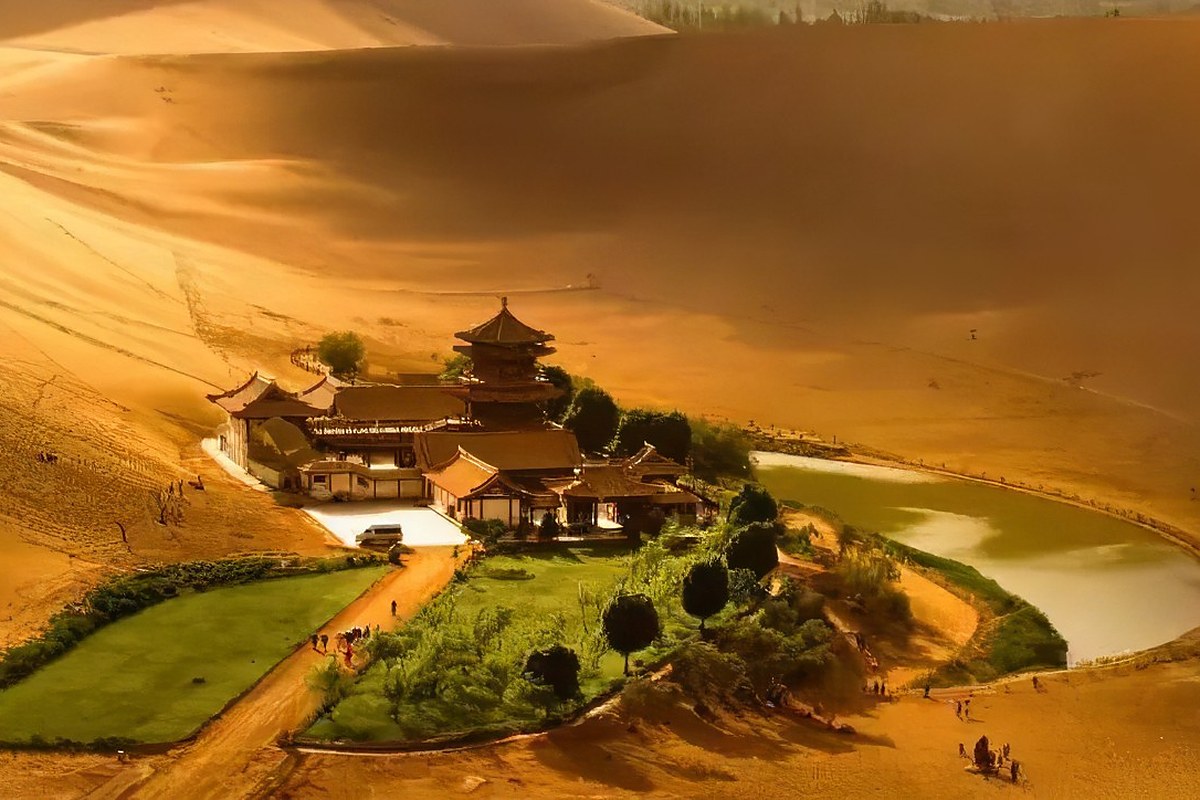
What I eat: Dunhuang’s donkey meat yellow noodles – springy wheat noodles with a dark savoury donkey-meat sauce – and a cold apricot peel drink, which is the best antidote to desert dust I know. The Shazhou night market is fun for atmosphere but I eat one street back, where the prices are lower.
What I actually remember from this evening is not the photograph. It is the temperature change. At 6 p.m. the sand is still warm under your shoes; twenty minutes after the sun drops behind the ridge, the same sand is cold enough that you put your socks back on. The wind comes up and makes a low, steady hiss against the dune face, and somewhere behind you a camel bell goes past, once, then fades. Nobody in the group says much on the way down. When the lights come on around the spring pavilion, the water is a small, impossible strip of dark green in all that sand, and I have seen grown adults just stand there for five minutes. On my last trip one guest said, very quietly, “I didn’t expect it to be this quiet.” That is the bit no itinerary table can give you.
Where I sleep: near Shazhou night market in Dunhuang town for most travellers. If you want the desert experience, there are guesthouses by the dunes, but you trade away restaurants and an early-morning grottoes transfer.
Day 4 – Mogao Grottoes, then fly out
The Mogao Grottoes are the reason many people come to this part of China: nearly 500 decorated caves cut into a cliff face, spanning a thousand years of Buddhist art. A standard ticket includes a short film, a guided visit to about eight to ten caves and access to the museum. Photography inside the caves is prohibited, and I mean it – the flash damages pigments and staff will stop you.
I book the earliest slot available, usually 8 a.m., both for the light on the cliff facade and because the queues build fast. After the visit we go straight to Dunhuang airport or the railway station. If your flight is late, add the Dunhuang Museum instead of a second cave ticket.
Where to stay on a 4-day Hexi Corridor trip, and what I avoid
I use a simple rule: sleep in towns, not at scenic-area gates. Gate hotels are convenient for exactly one thing and expensive for everything else. In Lanzhou, stay in Chengguan district near the Yellow River so you can walk to the Zhongshan Bridge in the evening. In Zhangye, Jiayuguan and Dunhuang, a mid-range 4-star Chinese brand (or a well-reviewed boutique courtyard hotel in Dunhuang) gives you reliable hot water, breakfast and a short walk to food. Ask specifically for a non-smoking floor – smoking is still common in regional Chinese hotels, and it is the single most frequent complaint I hear.
One thing I would not do: book a different hotel every single night if you can avoid it. Four days already means three changes; consolidating Zhangye and Jiayuguan would save time but costs you the sunset and the fort, so the trade is worth it.
Food I would order again
- Lanzhou beef noodles – breakfast, cheap, and best before 10 a.m. when the broth is freshest.
- Zhangye cuo yu zi – short handmade noodles, hard to find outside the city.
- Jiayuguan lamb skewers – cumin and chilli over charcoal.
- Dunhuang donkey meat yellow noodles and apricot peel drink.
- Hand-grabbed mutton – plain-boiled, grass-fed, served with salt and garlic. Order it once on a cool evening.
Vegetarians do fine in the cities (noodle and vegetable dishes are everywhere) but should tell me in advance: much of the regional cuisine is meat-led, and “vegetarian broth” is not a safe assumption in small towns. Qinghai Lake’s naked carp is a protected species – it should never appear on your table.
Mistakes I see travellers make on this route
- Leaving Mogao tickets to the last day. reservations are name-based and tied to your passport. In July, August and around Chinese public holidays, the standard slots sell out days ahead. I book them before anything else.
- Visiting Zhangye Danxia at noon. you get washed-out colours and the worst heat of the day.
- Taking the cheapest unlicensed car. a 1,100 km desert route is exactly where you want a licensed operator, a driver who rests, and a vehicle with working air conditioning.
- Sand in everything at Mingsha. fine dune sand gets into camera bodies and phone ports. A zip bag and a lens cloth weigh nothing.
- Assuming cards work everywhere. international credit cards are unreliable outside big hotels here. Set up Alipay or WeChat Pay with a foreign card before you arrive, and carry some cash for small noodle shops and toilets.
- Paying for “costume photos” or unsolicited camel upgrades at scenic gates. agree a price before you sit on anything, and let your guide do the talking.
Practical notes before you go
Climate: desert days and cool nights. Even in July I pack a light shell for the dune sunset; in May and October I add a fleece. UV is fierce – high-SPF sunscreen, sunglasses and a brimmed hat are not optional. Health: this is the low-altitude part of northwest China, around 1,500 m, so altitude sickness is unlikely; dehydration and sun are the real risks. Documents: carry your passport every day, because grottoes and several scenic sites verify the name on the reservation. Connectivity: a roaming eSIM or a Chinese SIM with a VPN arranged before arrival – Google, WhatsApp and Instagram do not work on local networks without one. Toilets: on the long Jiayuguan-Dunhuang stretch, facilities are basic and occasionally squat-style; carry tissues and hand sanitiser. Timing: avoid the first week of October (National Day holiday), when every scenic site on this route is at its busiest and hotel prices double.
What this trip actually felt like
On the second afternoon, standing on the rampart at Jiayuguan, the wind was strong enough that I had to hold my hat and shout to be heard. A guest from Melbourne looked west at the empty gravel and the snow line, and said, “So this is where it just… stops.” That is the sentence I carry from this route. The Hexi Corridor is not a collection of ticketed attractions; it is a thousand kilometres of oasis towns that only exist because a line of meltwater comes off those mountains, and at the pass you can feel exactly where the wall, the farms and the old road ran out of world. Four days is tight, and I will not pretend otherwise – there are two long drives and one rushed morning. But if you give me four days, this is the feeling I am trying to get you to, and I would rather you arrive at it tired than skip the fort to arrive comfortable.
The questions people asked me afterwards
“You keep saying four days is the minimum. What did you actually cut?” Matisi grottoes south of Zhangye, the Yadan landforms west of Dunhuang, the second dawn visit to the dunes, and any slow morning anywhere. I also cut the idea of a relaxed lunch. What I refused to cut was the full two hours at Jiayuguan and an 8 a.m. Mogao slot, because those are the two places where rushing makes the whole trip feel pointless. If you want the grottoes AND the desert, something else has to give – and it should be the number of dune activities, not the history.
“Is the Mogao ticket really that hard to get, or is that guide-speak?” It is real. A couple last spring booked everything else themselves and left the grottoes until they arrived in Dunhuang. Peak week, no standard slots left. They did the Digital Centre’s replica caves and the films, which are genuinely good, but they did not step inside an original cave. I could hear the disappointment in the message they sent me. Tickets are timed and tied to the passport name, so I need your passport details at booking, not at the hotel. It is the first thing I secure, before the rooms.
“What did you eat that you didn’t like? Be honest.” Fair. Donkey meat yellow noodles are a Dunhuang institution and about half my guests love them; the other half find the dark sauce too rich and go for a plain bowl of noodles instead. And the Shazhou night market is fun for the noise and the lights, but I eat one street back where the locals queue – same skewers, roughly half the price, no one trying to upsell you a “special” barbecue platter. I would also skip the camel photo packages at the dune gate; agree a price before you sit on anything, and let me do the talking.
Frequently asked questions
Is 4 days enough for the Hexi Corridor?
Yes, if your goal is the classic highlights: Zhangye Danxia, Jiayuguan Pass, Mingsha Mountain and Crescent Spring, and the Mogao Grottoes. Four days is the shortest version I would sell. You lose the ability to linger at any one site, and you will not add Qinghai Lake or the Qilian grasslands.
Can I do the Hexi Corridor in 3 days?
Technically yes, by taking the high-speed rail and cutting either Jiayuguan or a full Mogao visit. I do not recommend it: the route becomes two long travel days and one rushed sightseeing day. If you only have three days, base yourself in Dunhuang instead and do the grottoes, dunes and Yadan National Park properly.
Do I need a private car, or is public transport enough?
High-speed rail covers Lanzhou-Zhangye-Jiayuguan-Dunhuang (Liugou South station for Dunhuang) well. But the last mile to Danxia, the dunes and the grottoes is where a car and driver earn their cost. I usually combine one rail leg with a private vehicle.
When is the best month for this itinerary?
Late April to June and September to October. July and August are very hot in Dunhuang (often above 35 C) and the grottoes are busiest. Winter is quiet and cheap, but some desert activities and the dune sunset become unpleasant in the wind.
Is the Hexi Corridor suitable for children or older travellers?
Generally yes – altitudes are low and walking is short. The two caveats are the dune climb at Mingsha (steep ladder, avoidable by staying on the flat path to the spring) and the long driving days. I build in a longer lunch and a rest stop for families.
This is the 4-day route I run as a private tour: Classic Hexi Corridor – 4-Day Private Tour from Lanzhou to Dunhuang. For help deciding between 3, 5 and 7 days, see How Many Days Do You Need for the Silk Road?, and for seasonal detail, Best Time to Visit the Hexi Corridor.