
The bluntest message I got this autumn: “Is Ejina actually worth two six-hour drives, or is it just Instagram?” I appreciated it. I get a lot of questions that are really asking permission to skip something, and this one deserved a straight answer rather than a sales pitch. So I wrote back: for four minutes at Erdaoqiao at dawn and twenty minutes sitting in the Dead Tree Forest at sunset, yes. If you hate 5 a.m. starts, long empty roads, or the possibility that one windy night stripped the leaves before you arrived, then no, and I would rather you take the six-day Jinta route instead. Below is the version I run, with the parts I would do differently if I were booking it myself.
Short answer: Ejina (Ejin Banner, Inner Mongolia) has the most dramatic desert poplars in China – ancient, twisted Populus euphratica standing in sand – but the colour window is only about two to three weeks, usually late September to mid-October, and the first week of October is the busiest travel week in the country. Seven days is the shortest version I would run: it gives you two nights in Ejina, a sunrise at Erdaoqiao, the Hero Forest at Sidaoqiao, the Badain Jaran desert edge at Badaoqiao, and a sunset at the Dead Tree Forest, without trying to squeeze Mogao into the same afternoon.
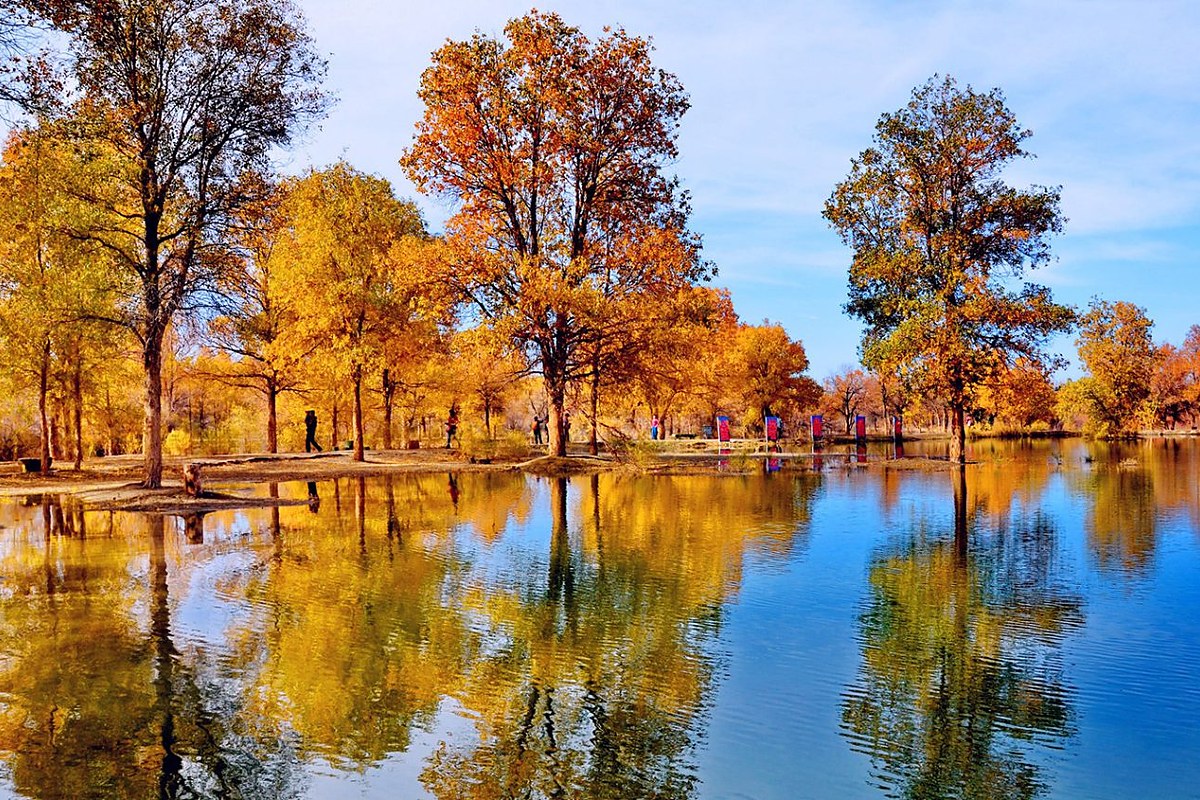
It is 5:20 a.m. at Erdaoqiao and it is genuinely cold – the kind of cold that makes you regret leaving your gloves in the car. We walk in with headlamps off, because the boardwalk is full of tripods and nobody wants to be the person who ruins a long exposure. You can hear people breathing and the occasional click of a shutter, and not much else. The water is black and completely still. Then the sky goes grey, then pale, and the first light hits the top of the poplars on the far bank, and for about four minutes the trees and their reflection are the same saturated gold with no horizon between them. A few people actually exhale at once. By 7:30 the sun is up, a breeze has wrinkled the water, and the moment is over. I have done this dawn in the second week of October with maybe forty people on the boardwalk, and in the holiday week with several hundred. Same trees. Completely different experience. That difference is the single most important planning decision on this route.
At a glance: 7 days to Ejina and back
| Route | Lanzhou – Zhangye – Jiayuguan / Jinta – Ejina (2 nights) – Jiuquan – Dunhuang |
| Colour window | Typically late September to mid-October; peak about 2-3 weeks, movable by frost and wind |
| Longest drives | Two days of roughly 380-420 km each, Jiayuguan to Ejina and back |
| Crowds | Extreme in the first week of October (National Day holiday); moderate outside it |
| Altitude | Around 1,000-1,700 m. Not a high-altitude trip |
| Book first | Ejina accommodation, then Mogao Grottoes timed tickets, then everything else |
I’ll be honest about this route: it is the one I plan most carefully and the one where I most often tell guests to change their dates. Ejina is a small town with a very short season. When the trees turn, the entire country seems to arrive at once. Here is the version that works, including the parts I would do differently if I were booking it myself from scratch.
Day 1 – Lanzhou to Zhangye
Lanzhou beef noodles for breakfast, a short walk at Zhongshan Bridge over the Yellow River, then the high-speed rail west to Zhangye (about 3 hours). I use the train here to save driving hours for the Ejina legs. Dinner in Ganzhou district: cuo yu zi noodles. Where I sleep: in town, not at the Danxia gate.
Day 2 – Zhangye Danxia at sunset
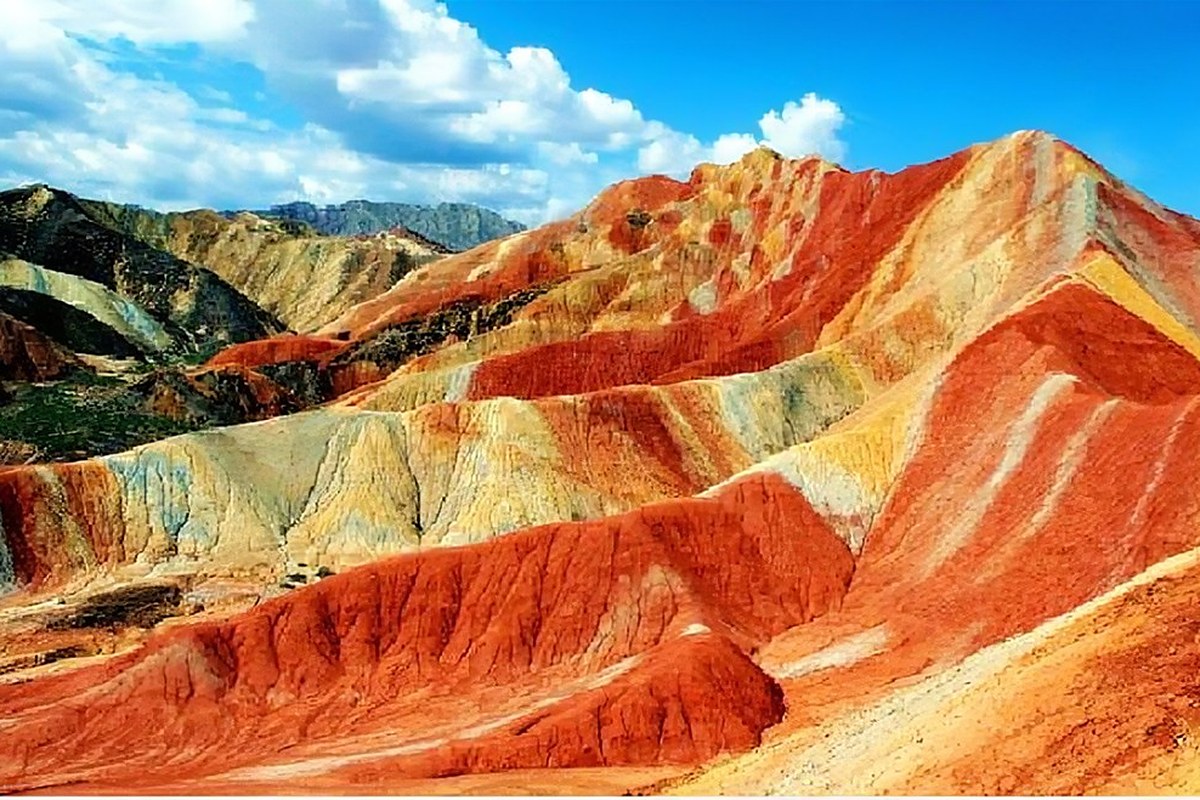
A slow morning – the Giant Buddha Temple if guests want it – then Zhangye Danxia National Geological Park about 2.5 hours before sunset. West gate, shuttle to platform 4 for the classic layered panorama, then platforms 2 and 1. The coloured sandstone crust is fragile: stay on the boardwalks, and do not go at noon, when the colours wash out and there is no shade.
Day 3 – Jiayuguan, Jinta, then the long road north to Ejina
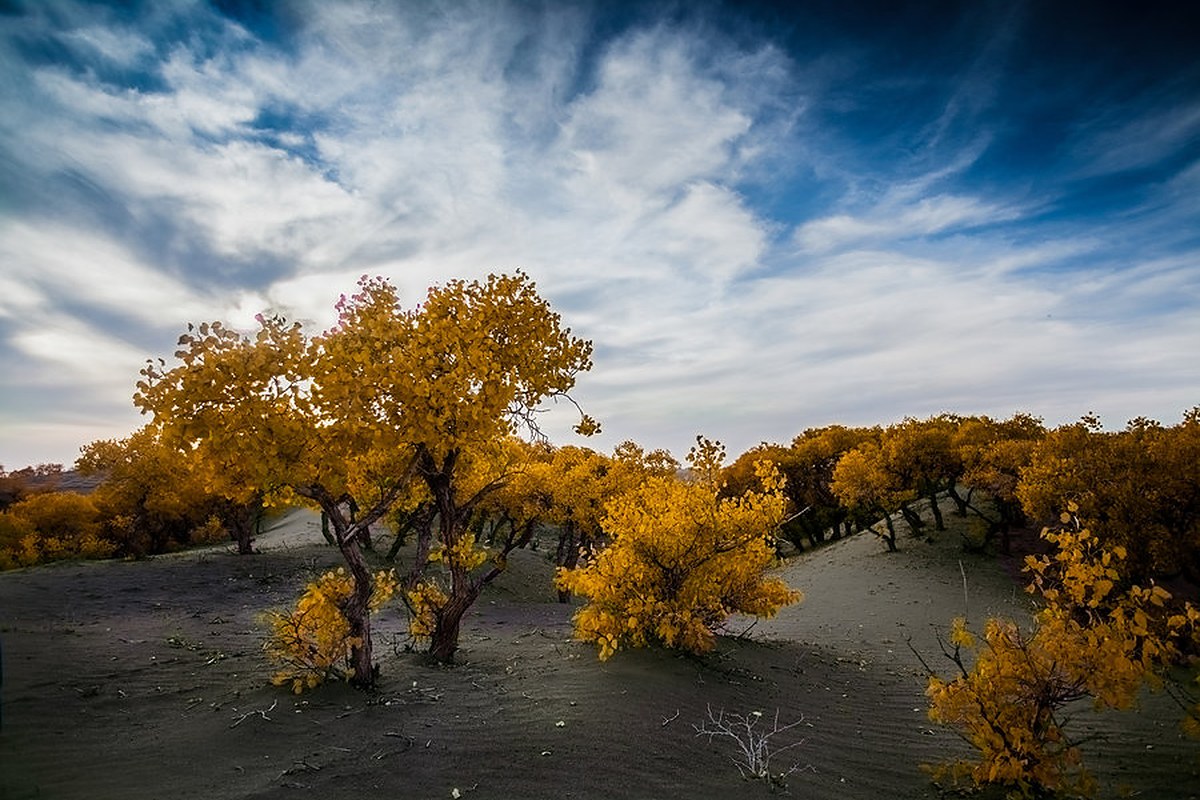
Morning at Jiayuguan Pass, the western end of the Ming Great Wall: ramparts, inner fort, the small museum on rammed-earth construction. Then a quick look at Jinta Poplar Forest near Jiuquan if the colour is on – it usually turns a few days earlier than Ejina, so it is a useful backup if the northern groves are late. After lunch, the long drive north (roughly 380-400 km, 5-6 hours) into the desert to Ejina town.
This is the day I would reconsider if I were planning again: leaving after lunch means arriving after dark. On my own trip I would cut the Jiayuguan museum short and depart by 11 a.m. so we see the desert change colour on the way and still get a proper dinner.
What I eat: Jiuquan hand-grabbed mutton before the drive; in Ejina, a simple Mongolian-style milk tea and lambhotpot dinner. Where I sleep: Ejina town, booked weeks ahead.
Day 4 – The full Ejina day: sunrise, hero trees, desert, dead trees
This is the day the whole trip exists for, and I start before dawn. Erdaoqiao (Second Bridge) is the reflection forest – poplars in shallow water, and the sunrise shot everyone comes for. Arrive in the dark, walk in, and hold your spot; by 8 a.m. the boardwalk is shoulder to shoulder in peak week.
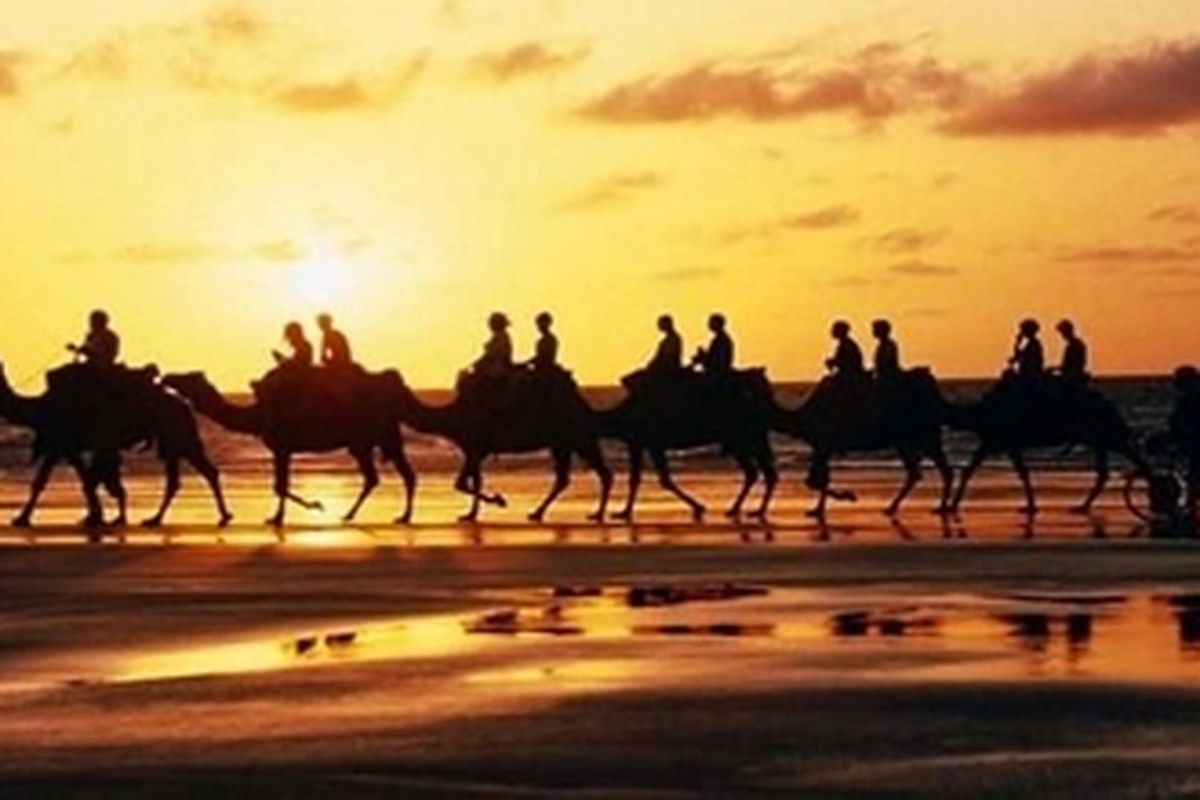
Mid-morning, Sidaoqiao (Fourth Bridge), the “Hero Forest”: the oldest, most sculptural trunks, with thick, deeply furrowed bark. This is where a 70-200 mm lens earns its place – isolate one trunk against the sand rather than shooting the whole grove. Late afternoon, Badaoqiao (Eighth Bridge) at the edge of the Badain Jaran Desert for dunes and camel silhouettes; and at sunset, the Dead Tree Forest (Guai Shu Lin), where bleached, skeletal poplar trunks make one of the strangest and most photographed landscapes in China. Dusk is the only time to shoot it.
Also worth it if time allows: the Black City (Khara-Khoto) ruins, a Tangut-era abandoned city in the desert, best in late afternoon. I treat it as optional, because the site adds a long drive to an already full day.
But the place that changes the mood of the whole day is the Dead Tree Forest at sunset. These are not golden trees. They are bleached, skeletal trunks, hundreds of them, twisted into shapes that look painfully like bones, standing in pale sand with no leaves at all. The wind moves through them with a hollow sound. Groups get very quiet there – not spooky quiet, just the quiet of people who have run out of things to say. I watched a photographer sit down on the sand for twenty minutes without taking a frame, then stand up and say he had no idea what he had just been looking at, and that he liked it. If you come all this way for the golden groves and skip this, you have seen the postcard and missed the desert. Go at dusk, when the low light rakes across the trunks; at midday it is just a hot field of dead wood.
Day 5 – Ejina back to Jiuquan
A second sunrise at Erdaoqiao if the first was cloudy, then the 5-6 hour drive back south. I stop at the roadside viewpoints rather than pushing straight through, and I never schedule a paid site on this day – it is a transit day, and pretending otherwise is how itineraries fall apart. What I eat: Jiayuguan charcoal-grilled lamb skewers on arrival, which after two days of simple desert food tastes extraordinary.
Day 6 – Dunhuang: Mingsha Mountain and Crescent Moon Spring
Morning drive to Dunhuang, rest through the afternoon heat, then the dunes around 5 p.m. I buy the re-entry ticket for a dawn return. Sunset from the dune ridge via the wooden ladder, then down to the Crescent Moon Spring pavilion in the dark. Camel rides are a short loop, not a desert expedition; agree any price before you sit down. Fine sand ruins camera bodies and phone ports, so the zip bags come out first.
Day 7 – Mogao Grottoes and departure
An 8 a.m. slot at the Mogao Grottoes – two films, a guided visit to eight to ten caves, the exhibition centre. No photography inside the caves; the pigments are light-sensitive and staff will stop you. The Digital Centre’s replicas are where you take pictures. Then the airport or station. If your flight is late, the Dunhuang Museum is a better use of two hours than a second cave ticket.
Where to stay, and the booking that decides this trip
Ejina town is the bottleneck. It has a limited number of hotels and a two-week season. In peak week, rooms that cost US$50 in June can be three to five times that, and the good ones are gone a month or more ahead. I book Ejina first, then fit the rest of the route around it. Elsewhere: Zhangye and Jiayuguan in town, Dunhuang near Shazhou night market; a Chinese 4-star is US$45-90 in normal weeks. Always request a non-smoking floor. For a dune-side courtyard hotel in Dunhuang, use the last night only.
If Ejina rooms are gone, my honest advice is to move the trip by a week or switch to the 6-day Jinta itinerary rather than accept a two-hour commute from a distant town before a 5 a.m. sunrise.
Food I would order again
- Jiayuguan charcoal lamb skewers – cumin, chilli, charcoal, ordered by the handful.
- Hand-grabbed mutton in Jiuquan – plain-boiled, grass-fed, with salt and garlic.
- Mongolian milk tea and lamb hotpot in Ejina – the right food for a cold desert dawn.
- Dunhuang donkey meat yellow noodles and cold apricot peel drink.
- Guazhou and Jiuquan melons – remarkably sweet in the dry autumn.
What I would do differently next time (the real pitfalls)
- Not travel in the first week of October. National Day holiday is the single biggest avoidable problem on this route. The second and third weeks of October are usually still golden and far calmer.
- Not treat peak colour as a calendar date. frost timing shifts it 7-10 days; one windy night can strip a grove completely. I keep the Ejina days movable and check local reports weekly.
- Not arrive in Ejina after dark. depart Jiayuguan by late morning on day 3.
- Not try to see all eight “bridges”. Erdaoqiao at dawn, Sidaoqiao mid-morning, Badaoqiao late afternoon and the Dead Tree Forest at sunset is a full day. Adding more means seeing everything badly.
- Book Mogao tickets early. passport-linked, timed, and gone in peak weeks – I secure them before hotels outside Ejina.
- Bring more warmth than feels necessary. dawn at Erdaoqiao in October is close to freezing, while the afternoon can be 20 C.
Practical notes
Climate: extreme day-night swing, very dry, intense UV even in cold air. Layers, high-SPF sunscreen, sunglasses and a hat. Altitude: around 1,000-1,700 m throughout – this is not a high-altitude route. Documents: carry your passport daily; several sites verify the name on the reservation. Money: set up Alipay or WeChat Pay with a foreign card before arrival, and carry cash for small shops, desert toilets and incidental fees – international cards rarely work outside large hotels. Connectivity: Google, WhatsApp and Instagram are blocked on mainland networks; arrange a roaming eSIM or VPN in advance, and download offline maps before the Ejina leg, where signal is patchy. Driving: the two long desert legs are paved but monotonous; I use a licensed operator with two rested drivers and never schedule paid sightseeing on them. Drones: permission is required at most scenic parks and near the ruins – ask first.
What this trip actually felt like
By the time we get back to Jiayuguan on day five, everybody is quietly wrecked – two 400 km days, two pre-dawn starts, dry sinuses, sand in places sand should not be. I always stop at the same little barbecue place and order a pile of lamb skewers and a cold beer, and every single time the table goes from exhausted to talkative in about ten minutes. Someone inevitably says the drive was worth it; someone else says they would not do the holiday week again; both are usually right. That is my honest answer to “is Ejina worth seven days”: yes, for the four minutes at Erdaoqiao and the twenty minutes sitting in the Dead Tree Forest, and for the strange, flat, silent road that gets you there. No, if you hate early mornings, long transfers or the possibility that a single windy night took the leaves before you arrived. I would rather tell you that now than sell you a guaranteed gold.
The questions people asked me afterwards
“Can we go during the National Day holiday? It’s the only week we have.” You can, and I have, but I want you to know what you are buying. Several hundred people on the Erdaoqiao boardwalk before sunrise, hotel rooms at three to five times their normal price, and a lot of time in queues. The trees are the same. The experience is not. If those are genuinely your only dates, I shift everything to dawn entries, book the hotels two months out and skip the mid-morning “bridge” circuit. Otherwise move to the second or third week of October – usually still golden, far calmer.
“What happens if the leaves have already fallen?” It is a real risk, and it has happened to me. That is why I keep Jinta as a colour backup on the way north, check local reports weekly, and never build the whole trip around one sunrise. The Dead Tree Forest, the Black City ruins, Jiayuguan and the Mogao Grottoes do not depend on leaf colour at all. I would rather tell you that now than send you home with a guarantee I cannot keep.
“Is seven days too much driving for someone who gets carsick?” Two of the seven days are roughly 380-400 km on straight, paved desert highway – monotonous rather than twisty, which helps some people and hurts others. I use a licensed operator with rested drivers, stop every 90 minutes or so, and never schedule a paid sightseeing stop on those days. If that sounds like too much, the six-day Jinta version cuts both of them and still gets you the golden trees.
Frequently asked questions
When is the best time to visit Ejina Poplar Forest?
Usually early to mid-October, with the strongest colour for about two to three weeks. The exact window moves with the first frosts. I recommend the second or third week of October rather than the National Day holiday week, when crowds and prices peak.
Is 7 days enough for Ejina and the Hexi Corridor?
Yes, but only just. Seven days gives you two nights in Ejina plus Zhangye Danxia, Jiayuguan, the Mingsha dunes and Mogao. Six days forces you to drop either the Dead Tree Forest or the Dunhuang half; eight to nine days lets you add Qinghai or the Qilian grasslands.
Should I choose Jinta or Ejina?
Jinta is a short detour from Jiayuguan, younger trees, lake reflections and light crowds. Ejina is ancient sculptural trees in desert sand, but needs two extra driving days and much earlier hotel reservations. If you have six days, choose Jinta; with seven or more, Ejina is worth the effort.
Do I need a 4WD for Ejina?
No. The highway from Jiayuguan/Jiuquan to Ejina is paved and a normal vehicle is fine. 4WD is only needed for the dedicated overland expeditions into high passes, Hala Lake or unpaved tracks.
What happens if the leaves have already fallen?
It is a real risk after a windy night. This is why I keep the Jinta stop as a colour backup, check local reports a week out, and avoid building the entire trip around a single sunrise. The Dead Tree Forest, Black City ruins, Jiayuguan and Mogao do not depend on leaf colour at all.
The route behind this guide: Ejina Poplar Forest & Hexi Corridor – 7-Day Private Tour. For the shorter autumn option see Jinta Poplar Forest – 6-Day Private Tour, and for month-by-month weather read Best Time to Visit the Hexi Corridor.